Feature
Billing & Revenue Automation
Bill open-ended hires, subscriptions and metered usage automatically — with late fees, refunds and depreciation handled by sweeps instead of spreadsheets.
Billing that runs while the hire runs
The most valuable hires are often the ones without an end date. Plant on rolling contracts, welfare units on site until the job is done, equipment that renews month after month until someone says stop. Most rental software assumes every hire ends — so open-ended revenue ends up billed from a spreadsheet somebody has to remember to open.
Renttix treats no-end-date hires as first-class. A rental can run indefinitely against a card on file, billed on the cycle you choose — weekly, four-weekly, monthly, quarterly, or yearly. Charges run through your own payment account, so the money settles with you directly; Renttix never holds it. Customers see every running subscription in their portal — what is billing, its status, the next bill date — and can update the card on file themselves when a payment fails, without a phone call.
The chasing is automated too. A customer who pays their first cycle but never saves a card gets a scheduled sequence of reminders — a nudge, a final warning, then a flag to your team. When equipment goes past its return date, a daily sweep computes the late fee, records it against the order as it grows, and tells the customer once that fees are accruing. Charging the fee stays a deliberate action by your team — automated detection, human decision — which keeps the audit trail clean and disputes rare.
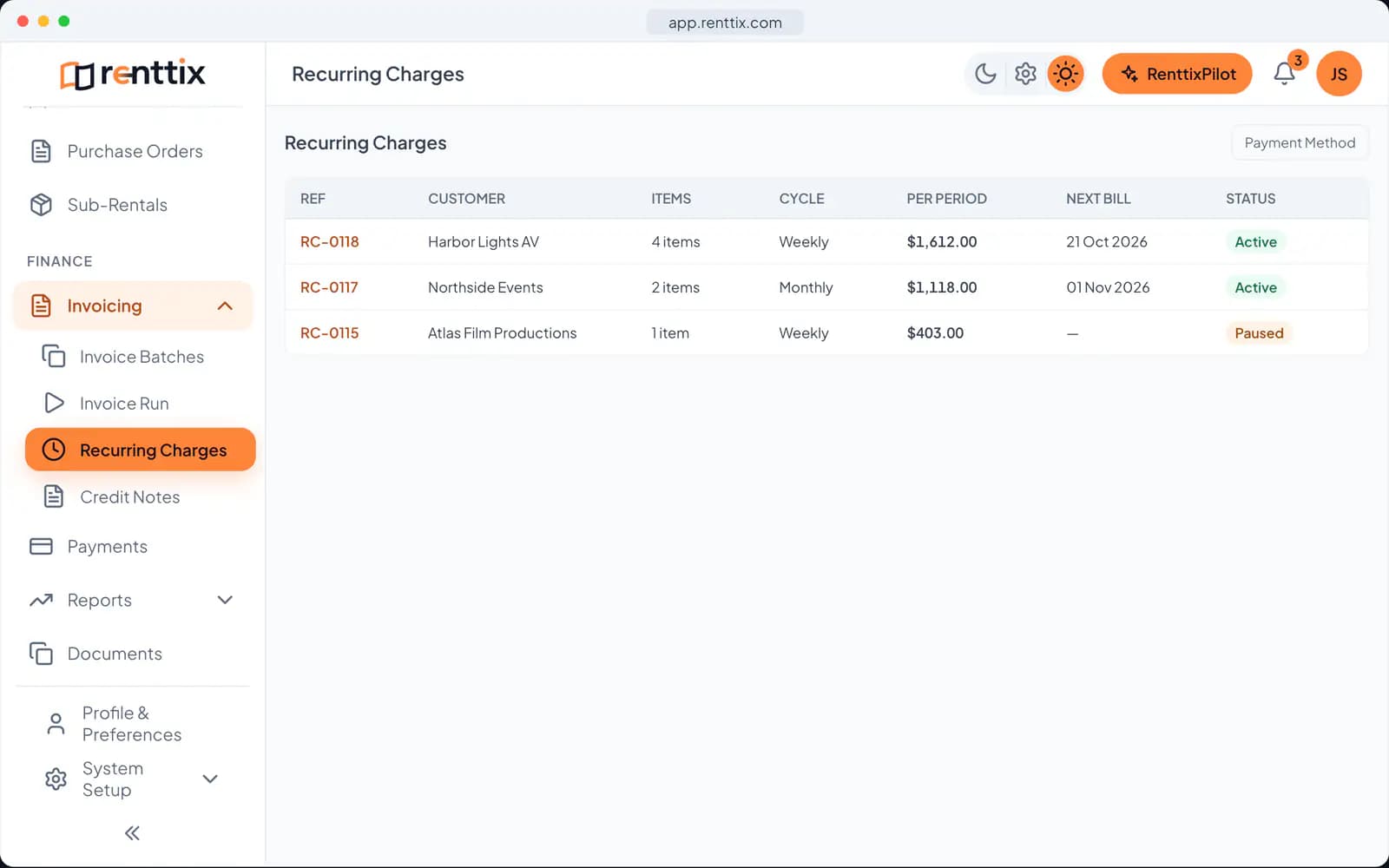
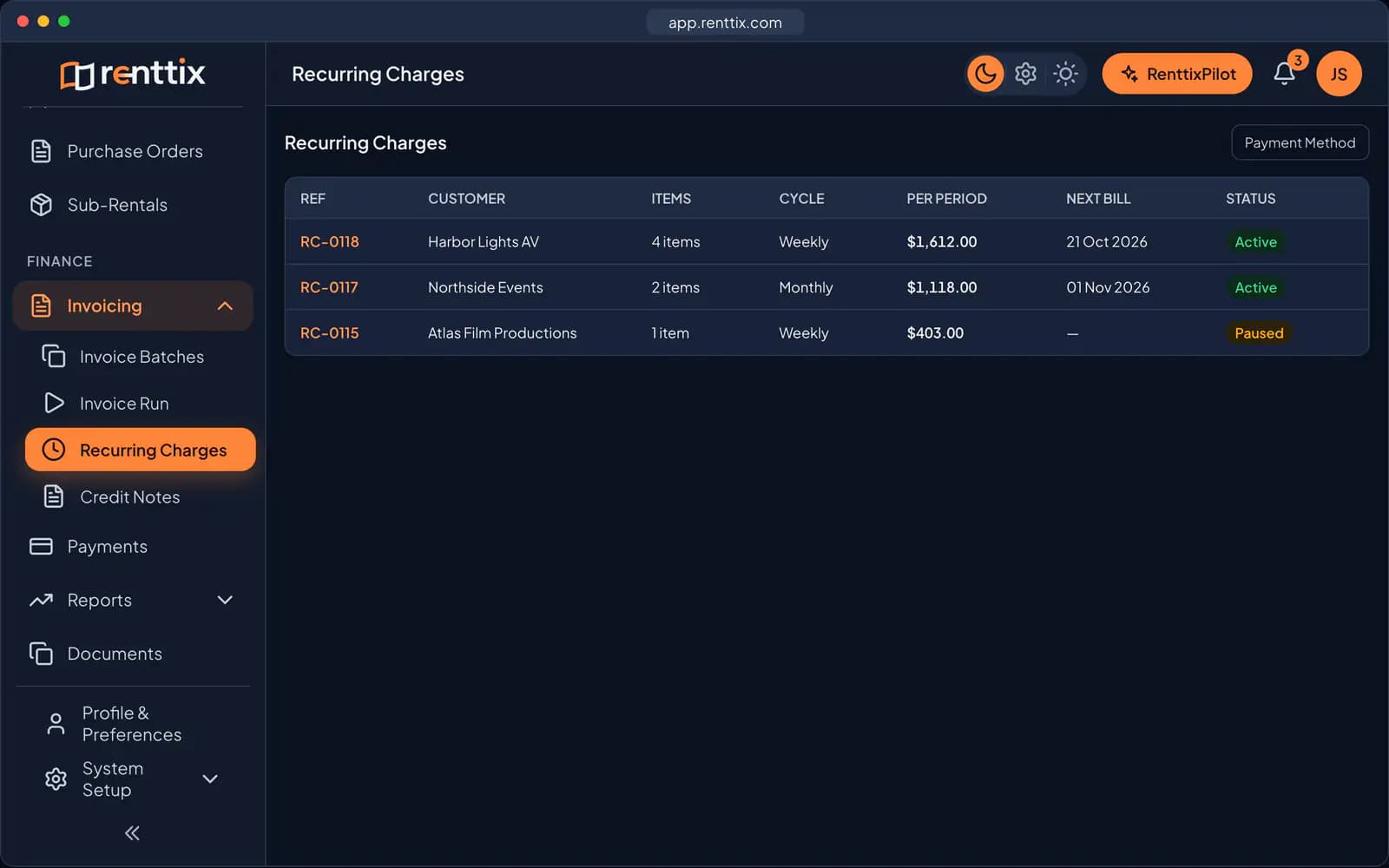
A recurring-charges screen in invoicing shows every running arrangement in one place: what is billing, on which cycle, for how much. Long-running revenue managed like a book of business, not a pile of sticky notes.
Charge for what actually happened
Metered plant earns by usage, not just by the day. A Renttix rate can include an allowance of free units per day — engine hours or mileage — with overage billed per unit beyond it. Readings are captured at book-out and off-hire, typed in by whoever is standing next to the machine or pulled from the asset's mapped telematics device, and every reading is stored as an evidence trail, so the invoice can say which machine was read and when.
Discounts follow rules rather than habits. Customer tiers apply their percentage automatically; a line-level discount — percentage or fixed amount — replaces the tier rate rather than stacking on top of it, and every line records which discount applied. Promotional codes give your storefront a lever for quiet periods, and the no-stacking precedence means nobody discovers a double discount at month end.
Cancellations pay out by policy, not by negotiation. Each product carries its own cancellation policy — from full refund until dispatch, through notice periods and tiered refunds, to no cancellation at all — and the same engine runs whether the customer cancels in the portal or your team cancels in the back office. The customer sees the exact refund before they confirm, and orders mixing products with different policies take the strictest one.
When a subscription rental comes off hire mid-cycle, the refund is pro-rated over the unused days of the paid cycle, honouring the product's minimum rental period — and if a damage report is open, the refund waits until it is decided and nets off any charge. The customer gets a fair exit; you never refund money you were owed.
From accepted quote to posted journal
Quotes should not die in an inbox. Renttix sends each quote as a secure tokenised link — nothing to install, no account to create. The customer opens it, asks questions in comments your team sees immediately, accepts with an electronic signature, pays online or goes on account, and downloads the PDF for their records. Declines are captured with a reason, and your team is notified the moment either happens.
Acceptance can go straight to an order. With auto-conversion enabled, an accepted quote becomes an order using your order defaults — no re-typing, and the same acceptance can never create two orders.
At the other end of the revenue story, assets quietly lose value, and someone has to account for it. A monthly sweep computes straight-line depreciation for every asset with a purchase price and a depreciation rate on its product, and posts the expense and accumulated-depreciation journal directly into QuickBooks, Xero, Sage, Zoho Books, or MYOB. Book values step down month by month, fully depreciated assets stop posting, and re-running a month never posts it twice.
Because journals are only as reliable as the connection they travel over, Renttix tests the accounting link on demand and keeps the result — provider, company name, how long the round trip took, when it last ran — on the accounting mappings card. A broken connection shows up there as a failed test with a timestamp — caught in seconds from the admin screen, not weeks later as a journal that silently never arrived.
Follow one rental
Where this happens to R-2417
A sample rental: the customer and figures are made up. The statuses and screens are Renttix’s own.
Rental recordSample
R-2417
Step 9 of 9 · Invoice
- Invoice
- Invoice · Paid
- Accounts
- Synced
| Site dumper × 2 · 14 days | $2,380 |
|---|---|
| Mini excavator · 14 days | $1,750 |
| Delivery and pickup | $190 |
| Damage repair, DM-1157 | $230 |
| Total before tax | $4,550 |
- AccountsInvoice INV-30412 raised in the weekly invoice run
- AccountsInvoice synced to QuickBooks
See this stage in the walkthroughSee this screen in the live demo
Billing automation FAQ
Can Renttix bill hires that have no end date?
Yes. A rental can run indefinitely against a card on file, billed weekly, four-weekly, monthly, quarterly, or yearly through your own payment account. Reminder sweeps chase missing card details, and a recurring-charges screen shows every running arrangement in one place.
How does metered usage billing work?
A rate can include free engine hours or mileage per day, with overage billed per unit beyond the allowance. Readings are captured at book-out and off-hire — entered manually or pulled from the asset's telematics device — and each reading is stored as evidence for the invoice.
Are late fees charged automatically?
They accrue automatically. A daily sweep computes the fee on overdue rentals, records it against the order as it grows, and notifies the customer once. Actually charging the fee is a deliberate action by your team, which keeps the audit trail clean and disputes rare.
What does a customer see before cancelling?
The exact refund, computed from the product's cancellation policy, before they confirm. The same engine applies when your team cancels in the back office, and subscription rentals ending mid-cycle are refunded pro rata for the unused days, honouring minimum rental periods.
Related features
Global Payments & Tax
Take payments the way your market pays and calculate tax the way your region demands — wherever you operate.
Customer Portal
Give customers a self-service portal for orders, invoices, payments, and off-hire requests — and take the phone calls off your team.
Kits, Bundles & Pricing Control
Hire packages that book as one, rate structures that price themselves, and fleet-wide price changes you can schedule and reverse.
Workforce
Hours, pay, absence, records and compliance for the people who run your hire business — clock-in through to payroll export, built into Renttix and the Renttix Field app rather than bolted on beside it.
Warehouse & Depot Operations
Run picking, returns, and van stock with scan-driven accuracy — depot queues that keep every order moving.
Online Store & Booking Widgets
Take bookings from your website, your webshop, or a store we host — with availability and deposits handled by the platform.
Workshop Command Centre
A live board for every engineer, estimates customers approve online, and parts on the bench before the job stalls — the workshop run with the same discipline as the hire desk.
Open your first rental record today
14-day free trial · Payments and deposits ready · Quick setup