

Published 21 September 2026
What electronic proof of delivery means in a hire business
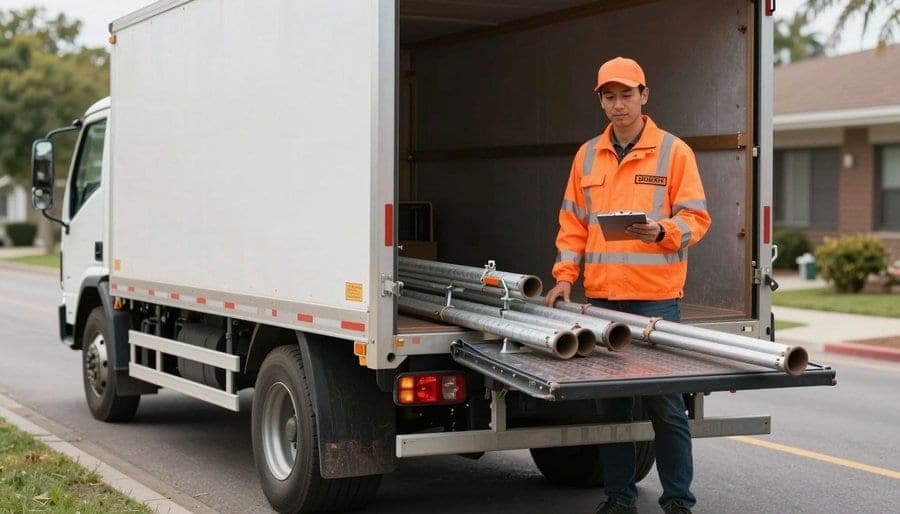
Electronic proof of delivery, usually shortened to ePOD, is the record a driver creates on a phone or tablet at the moment equipment changes hands: what was delivered, to whom, where, when, in what condition, and the customer's confirmation of all of that. In a courier business that record closes the job. In a hire business it does something more important, because the equipment is coming back. The delivery record becomes the baseline that every later question is measured against: was the machine damaged on site or before it arrived, did the hire start on the day the customer thinks it did, and were there twelve trench sheets on the lorry or ten.
Paper delivery notes were designed for a world where the office would see the signed copy a day or two later, if the driver remembered to hand it in. Carbon copies smudge, signatures are unreadable, photographs live on a personal phone, and the time written on the note is whatever the driver estimated when filling it in. None of that is a problem until a customer disputes an invoice, which is precisely the moment the note is needed.
An electronic record fixes the format rather than the driver. The same information is captured every time, in the same order, with a timestamp the driver does not choose, and it is in the office the moment it is saved. That consistency is what makes the record useful as evidence, and it is what lets the rest of the business, from invoicing to off-hire to damage recharges, rely on it.
What a good delivery record contains
The value of ePOD comes from the completeness of each record, not from the fact that it is digital. A photograph of a signature is not proof of delivery. The following elements are the minimum a hire company should expect its drivers to capture on every drop.
The order, the items and the quantities
The record should reference the rental order or hire contract it fulfils, list every line delivered with quantities, and identify serialised assets individually. If the order was for ten pedestrian barriers and eight went out because two were damaged in the yard, the record must show eight, or the off-hire count will never reconcile.
Where and when
The delivery address is not enough on a large site. Capture the specific location, whether that is the compound, the floor or the plot number, because the customer's site manager is rarely the person who unloads the equipment, and the collection driver may be someone else entirely. The time should be recorded by the device, not typed by the driver, so that the start of the hire and any waiting time are beyond argument.
Condition on arrival
Photographs taken at the point of delivery are the only evidence that separates damage on site from damage in transit or pre-existing wear. Wide shots that show the equipment in position, close-ups of anything already marked, and meter readings on powered plant all belong in the record. Our guide to photographing rental damage covers how to take pictures that hold up when a recharge is questioned.
Who accepted it
A signature drawn on the screen, with the printed name of the signer and ideally their role. If the customer's representative refuses to sign, or nobody is present, the record should say so explicitly and the photographs should show the equipment left in an agreed place. "Left on site" without evidence is the weakest position a hire company can be in.
Exceptions
Short deliveries, refused items, access problems, a request to drop the equipment at a different address: each needs to be recorded as it happens, with a reason. Exceptions written on the back of a delivery note rarely make it into the invoice.
The disputes electronic proof of delivery settles
Most hire disputes fall into a handful of patterns, and the delivery record is the answer to nearly all of them.
"It never arrived." A timestamped record with the location, photographs of the equipment in place and a signature ends this conversation before it starts. Without it, the company is relying on a driver's memory of a drop made three weeks ago.
"It was already damaged." Delivery photographs establish condition at handover. If the dented panel is visible in the delivery photo, it is not a recharge; if it is not, the recharge is supportable and most customers accept it.
"You delivered less than we were charged for." Line-by-line quantities on the delivery record, confirmed by the customer's signature, mean the invoice can be checked against evidence rather than against the original order.
"The hire should have ended last week." A delivery record starts the clock and a collection record stops it. When both carry device timestamps, the hire period is a matter of record, and a disciplined off-hire process becomes far easier to enforce.
Consider a tool hire depot with several hundred assets moving between customers every week. If delivery notes come back on paper at the end of each day, the office is typically two or three days behind the fleet: invoices go out based on what was planned rather than what was delivered, and every query means finding a note, deciphering a signature and phoning the driver. The point of an electronic record is not the tablet. It is that the office, the driver and the customer are all looking at the same facts on the same day.
Proof of delivery starts with the order
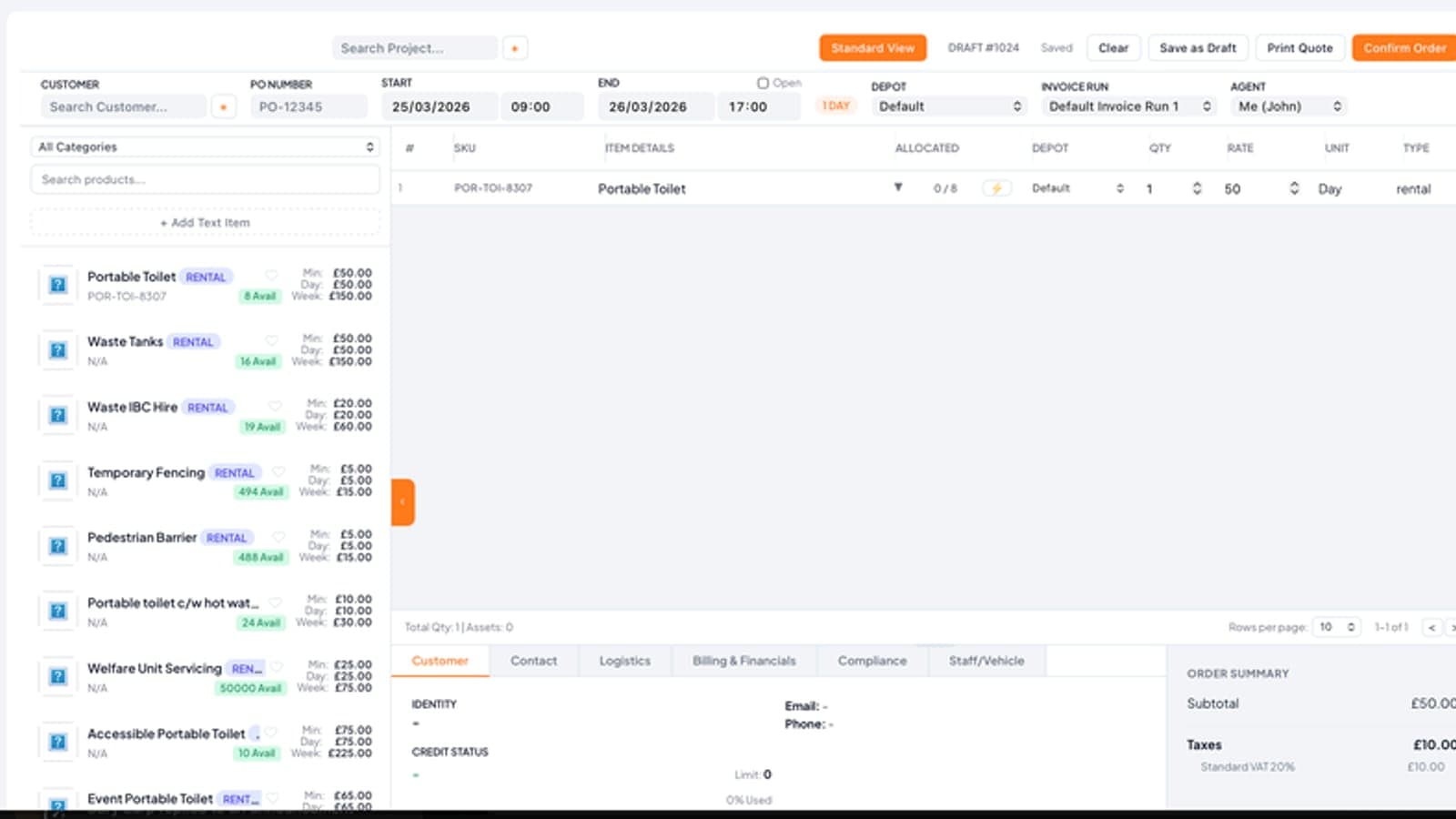
Drivers should never type what they are delivering. If the order already lists the items, quantities, asset numbers, site address, contact and delivery window, the delivery record should be generated from it, and the driver's job is to confirm, adjust and evidence rather than to re-enter. Every field a driver has to key in on a tailgate is a field that will eventually be wrong.
In Renttix, the rental order carries the logistics detail from the moment it is created: the items and quantities, the delivery and collection dates, and the site the equipment is going to. Delivery and collection jobs are planned from those orders on the dispatch board, grouped by route and assigned to drivers, so the job that reaches the driver's device already knows what it is for. The rental dispatch workflow covers how runs are planned and assigned; the delivery record is simply the last step of that same job. For customers on repeating visits, recurring schedules generate the jobs themselves, so the proof of delivery for a weekly visit is captured against the right visit without anyone re-creating it.
That link between order and record is what makes the evidence useful later. A signed record that references order 1024, line 3, serial number KX-2231 can be found from the order, from the asset or from the customer's account. A photograph in a driver's camera roll can be found from nowhere.
Capturing proof of delivery in the Renttix Field app
Renttix drivers complete deliveries and collections in the Renttix Field app, the same app engineers use for service jobs. On each job the driver captures a signature on screen, takes delivery or collection photographs and updates the job status, with the device's location recorded against the job. Each status change is visible to the office as it happens, so the question of whether the generator has reached the site yet is answered by looking at the job rather than by ringing the driver.
Two design decisions matter more than the feature list. The first is that the app is offline-first: signatures, photographs, checklist answers and messages are stored on the device and synced the moment a connection returns, so a basement plant room or a rural site does not mean a missing record. The second is that what has to be captured is a matter of policy rather than habit. Handover policies in Renttix define what proof must exist for equipment to change hands, whether signatures, photographs or meter readings, and the platform enforces that policy at the point of handover. A driver in a hurry cannot complete the job with the evidence missing, which is the failure mode of every paper system.
Where a visit involves work as well as a drop, such as a service on a welfare unit or a repair on hired plant, the field service management tools add checklists seeded from the task type, parts used from van stock and a job sheet the customer signs on site, which becomes a signed PDF immediately. The launch of Renttix Field is described in Renttix Field: service jobs, job sheets and customer sign-off.
Keeping the customer in the picture
Proof of delivery is also a customer-service tool, and the most useful moment to share it is before anyone asks. When a Renttix driver sets off, the customer receives a text or an email, whichever details are on file, with an estimated arrival time and a secure tracking link. The link opens a live map page with no login and no app to install, and the arrival estimate is recalculated from road routing as the page refreshes. Once the job is complete, the same page shows the proof of delivery.
The record then stays with the account. Through the customer portal, customers see their live orders, the equipment currently on each of their sites, their invoices and the documents attached to their account, proof of delivery included. When a site manager wants to know what was delivered on Tuesday, they can look rather than call, and the office spends its time on hires rather than on retrieving paperwork. The full picture of what Renttix offers for delivery communication is on the delivery experience page.
Collections: proof of delivery in reverse
Everything captured at delivery should be captured again at collection, because the collection record is what closes the hire and supports every charge that follows it. The time the driver arrived and the time the equipment was loaded establish the end of the hire period and any waiting time. Photographs at the point of collection establish the condition the customer returned the equipment in, before it has travelled on a lorry and sat in a yard. Quantities confirm what came back; missing items are recorded as missing on site, not discovered during a stock count a month later.
The collection record then hands over to the depot. In Renttix, returns are checked in with condition capture and damage flagging as part of the warehouse workflow, so the yard team's inspection is recorded against the same asset and the same order as the driver's photographs. When a damage recharge or a deposit deduction is raised, the evidence runs from delivery photo to collection photo to yard inspection without gaps, and without anyone assembling it after the fact.
Putting electronic proof of delivery in place
Moving from paper to electronic proof of delivery is mostly a matter of deciding what the record must contain and then removing the option to skip it. A few practical points from hire companies that have made the change:
Decide the minimum record for each kind of job, whether delivery, collection, service visit or swap-out, and configure it as a requirement rather than a suggestion. The record that saves you money is the one taken on the day nothing seemed wrong.
Give drivers a standard for photographs: how many, from which angles, and what to do when the customer is not present. Consistency matters more than volume.
Choose tools that work without a signal. Field work happens in basements, on new-build sites and in rural areas; a system that needs a connection to save a signature will produce gaps exactly where records matter most.
Make the record visible to the people who use it. Hire desk staff answering queries, the finance team raising invoices and the customer's own site manager should all be able to find the delivery record from the order, not from a shared drive.
Treat exceptions as data. Short deliveries, refusals and access problems should be captured with a reason, so that the invoice, the redelivery and the conversation with the customer all start from the same information.
Renttix covers the whole chain in one system: the order carries the logistics detail, dispatch plans the runs, the Field app captures the evidence, offline if it must, and the customer sees it through the tracking page and the portal. To see how that fits your fleet and your drivers, book a demo and we will walk through it with your own examples.
Frequently asked questions
Record the absence explicitly, photograph the equipment in the agreed location with enough context to show where it is, note the name of any contact spoken to by phone, and complete the job with those exceptions recorded. A record that says "no signature, left in compound B as agreed with the site manager, see photographs" is far stronger than an empty signature box.
It should not. Field tools designed for hire work store the signature, photographs and job details on the device and sync them when a connection is available. Renttix Field works offline-first for exactly this reason, so a record captured in a basement or on a rural site is not lost.
Same structure, opposite direction. Proof of collection records when equipment was collected, what came back, in what condition and who released it. Because it closes the hire period and supports damage and shortage charges, it deserves the same discipline as the delivery record.
Explore Renttix
Ready to modernize your rental operations?
Payments + deposits enabled • Quick setup