Feature
Developer API & Webhooks
Build on your rental data with a documented REST API, scoped keys, and webhooks that tell your systems what just happened.
A real API, documented and keyed
Sooner or later every serious rental business needs to get data in or out programmatically — a corporate customer wants a feed, a BI tool wants the numbers, an internal script needs to create orders.
Renttix exposes a versioned REST API for exactly that. Customers, orders, products, and the other core resources are available over clean JSON endpoints under /api/v1, with documentation served from the platform itself rather than a PDF from two versions ago.
Access runs on API keys you create and manage in the developer portal. Keys can be revoked instantly, and every key is scoped to your workspace — there is no master credential floating around a contractor's laptop.
Rate limits and logging are built into the same layer your own interface uses, so API traffic is governed and observable rather than a side door.
Webhooks instead of polling
Integrations that poll for changes are slow when you need them fast and wasteful the rest of the time. Webhooks invert the relationship: Renttix tells your systems the moment something happens.
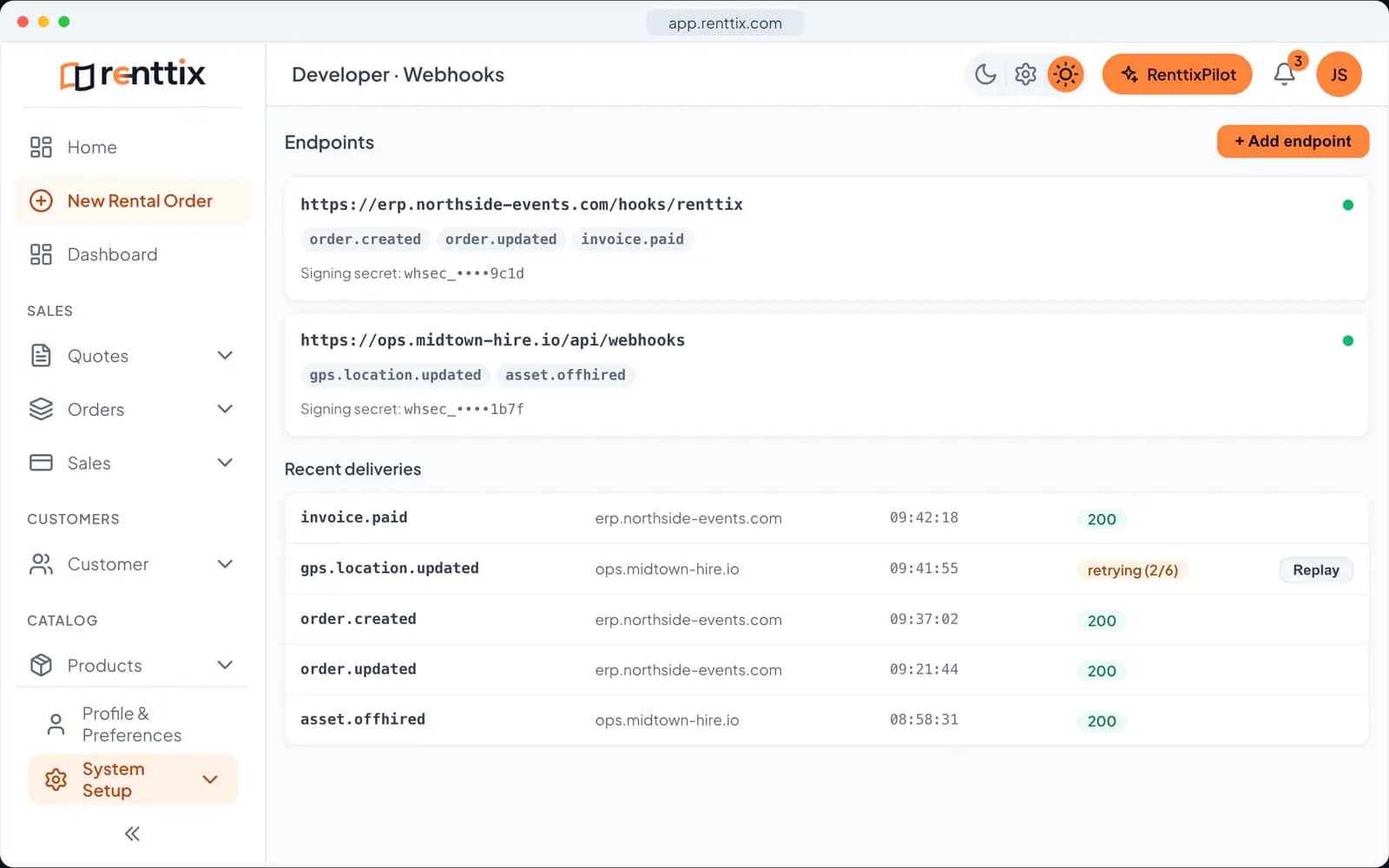
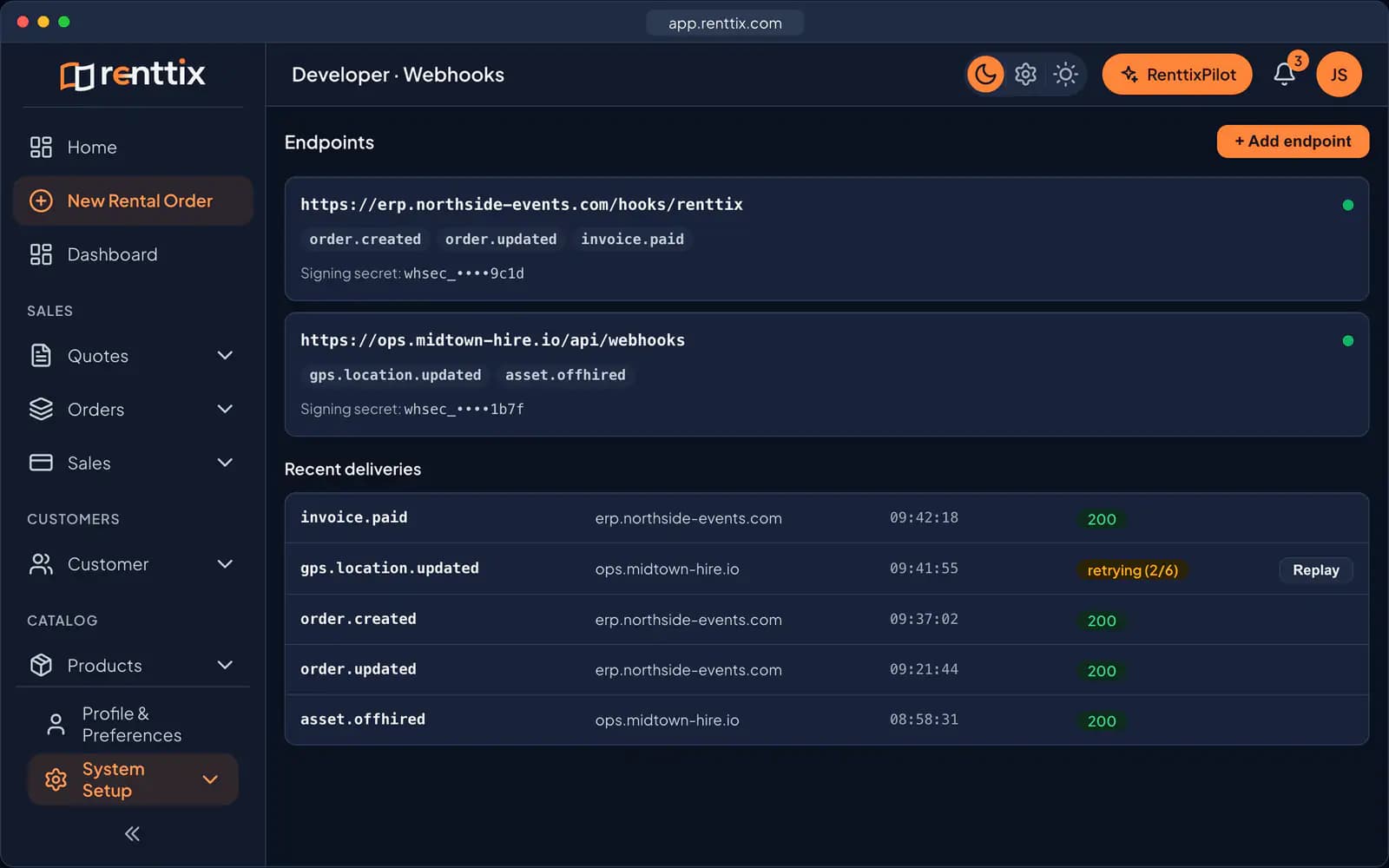
Register webhook endpoints for the events you care about and your systems receive a signed payload when they fire — an order created from your website can reach your CRM before the confirmation email reaches the customer.
Endpoints are managed alongside your API keys in the developer portal, and each delivery is logged so a missed message is a lookup, not a mystery.
Together with the API, webhooks make Renttix a platform you build on rather than a box you copy data out of. The system of record stays the system of record, and everything else stays in sync.
Request logs when you need to know what happened
Every integration eventually has its 3am question: what exactly did the system receive, and what did it answer?
The developer portal keeps request logs for API traffic — what was called, by which key, with what result — so debugging an integration is reading a log, not reconstructing events from both ends of a phone call.
The same discipline applies to the platform's own outbound connections. Accounting syncs, payment provider calls, and webhook deliveries are recorded, giving you a paper trail across every system boundary.
For businesses with development teams, this is the difference between a vendor and a platform: the machinery is inspectable, the credentials are yours to rotate, and the data is reachable the moment you need it somewhere else.
Developer API FAQ
What can we access through the API?
Core rental resources — customers, orders, products, and more — over versioned JSON endpoints under /api/v1, with documentation served from the platform. Access is controlled by API keys you create, scope, and revoke yourself.
Do you support webhooks?
Yes. Register endpoints for the events you care about and Renttix delivers signed payloads when they fire. Deliveries are logged, so missed messages are a lookup rather than a mystery.
How do we debug an integration?
Request logs in the developer portal record what was called, by which key, and what was returned — for inbound API traffic and the platform’s outbound connections alike.
Related features
Integrations & Platform Control
Enterprise Security & Access
Single sign-on, passkeys, two-factor, and role-based permissions — access control that satisfies your IT team, not just your ops team.
Online Store & Booking Widgets
Take bookings from your website, your webshop, or a store we host — with availability and deposits handled by the platform.
Field Service Management
Give engineers everything they need to complete service jobs on site — checklists, parts, labour, and signed job sheets.
Growth & Automation
Automation rules with dry-run and rollback, reminders that chase for you, loyalty and reviews that bring customers back.
Developer Platform & Ecosystem
Everything Renttix does, your developers can do too — a 600-operation API, official SDKs, signed webhooks, an app marketplace, and first-class support for AI agents.
Warehouse & Depot Operations
Run picking, returns, and van stock with scan-driven accuracy — depot queues that keep every order moving.
Open your first rental record today
14-day free trial · Payments and deposits ready · Quick setup