

Published September 22, 2026
A Scaffold Going Up Is the Start of a Long Story, Not a One-Off Booking
When a scaffold goes up on a construction site, the job isn't finished the moment the last plank is leveled and the access is signed off. That structure might stay exactly where it is for weeks, more often months, quietly running up a rental charge that has to be billed accurately for as long as it stands. At the same time, a scaffold left standing brings with it a standing obligation: regular safety inspections have to be carried out and evidenced, not just performed once and forgotten about. And somewhere in a yard, or spread across however many job sites are live at once, hundreds or thousands of individual tubes, boards and fittings have to be accounted for, because scaffolding isn't rented out piece by piece the way a single generator or excavator is. It goes out, and comes back, in bulk.
Get any one of these three things wrong and it shows up fast. Billing stops too early or keeps running too late because nobody logged the actual date the structure came down. An inspection is due and the certificate that proves it happened is sitting in an email inbox or a job-site folder nobody can find the moment a client asks for it. Or the yard simply can't say with any confidence how much tube, board and fitting stock is actually out on rent versus sitting unaccounted for, because it was never realistic to track thousands of individual components one by one. None of these are edge cases in scaffolding and access rental. They're the ordinary, recurring failure modes of the trade, and software built around how equipment actually moves through a rental business needs to handle all three, not just one. Renttix's approach to scaffolding rental is built specifically around that mix of long contracts, safety duties and bulk stock.
Recurring Billing for Structures That Stay Up for Months
Most equipment rental has a clear rhythm: a tool goes out, comes back a few days later, and gets invoiced once. Scaffolding rarely works that way. A structure erected around a building under renovation, or a tower supporting an extended construction schedule, can sit in place for months, and every week or month it stays up is another billing period that has to be raised, whether or not anyone in the office happens to remember that particular job site.
That's the pattern Renttix is built to bill against: rental charges for long-running job-site rentals are generated automatically on weekly or monthly cycles for as long as the structure remains recorded as up on site, with an off-rent date recorded the moment it comes down so that billing stops precisely then rather than continuing by accident. Manual invoicing over a timeframe measured in months is where this tends to go wrong in practice. A billing period gets missed because nobody was tracking which structures were still live, or a scaffold comes down but nobody tells the office, and the charge keeps running for weeks after the client has stopped owing for it. Automatic, off-rent-triggered billing removes both failure points: the charge continues only as long as the equipment is actually out, and it runs on the same underlying billing and revenue automation that handles the rest of a rental business's invoicing, rather than sitting apart from it as a special case.
Inspection Records and Certificates You Can Produce on Demand
A scaffold that's up for months doesn't get inspected once and left alone. Regular safety inspections are a standing obligation for as long as the structure remains erected, and every one of those inspections needs to be evidenced, not just carried out but recorded and kept somewhere it can actually be produced. The moment that matters most is rarely a quiet Tuesday afternoon. It's when a client, a general contractor or an inspector asks to see the paperwork, often with little warning, and "let me go look for it" isn't a good enough answer.
Renttix logs safety inspections and stores the accompanying certificates against each individual rental, so the record of what was inspected, and the certificate that proves it, sits attached to the job it belongs to rather than in a separate filing system that has to be cross-referenced by hand. When a client or inspector asks, the answer is a lookup against the rental, not a search through email threads or job-site paperwork. That record-keeping sits alongside the platform's wider rental compliance software, which is where the certificates, inspection history and due dates for a scaffolding fleet live day to day, rather than being scattered across whichever system or folder happened to be open when an inspection was actually carried out.
This matters as much for the business's own protection as for the client's peace of mind. A scaffold that has quietly missed an inspection window because nobody flagged it is a liability sitting on someone else's job site with the rental company's name attached to it. Keeping inspection records tied to the rental, rather than to whichever inspector happened to file the paperwork, means a due inspection is visible before it becomes an overdue one.
Bulk Stock: Tracking Tube, Boards and Fittings by Quantity, Not by Pole
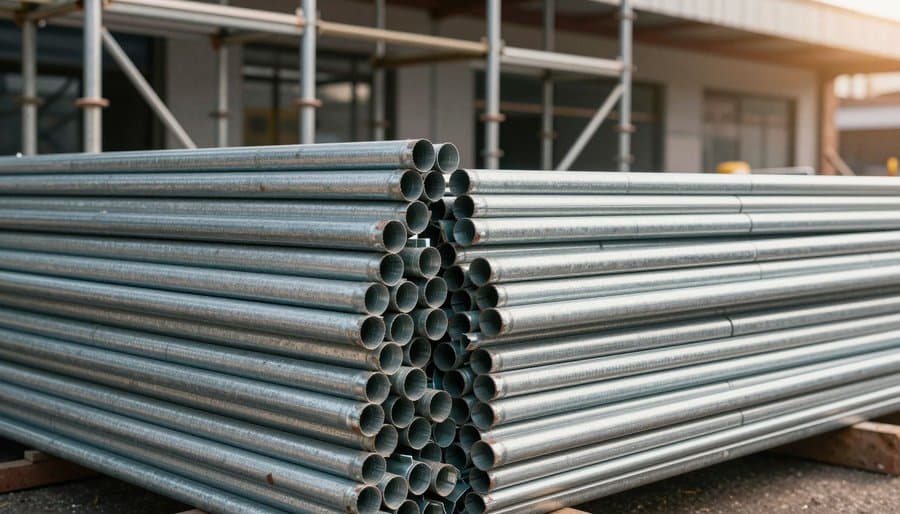
A scaffolding yard doesn't deal in single named assets the way an equipment rental business might track one particular excavator. It deals in volume: hundreds of tubes, dozens of boards, and a mix of fittings, couplers and clips, issued out to a job site in bulk and, eventually, returned in bulk. Trying to track each individual pole as its own serialized asset isn't a realistic model for this kind of stock. It never has been, and software that insists on it is solving a problem scaffolding businesses don't actually have while ignoring the one they do.
The real unit of control here is quantity: how much tube, board and fitting stock went out to a given site, and how much of it came back. Renttix tracks the quantities of tube, boards and fittings issued to each site and returned from it, so a yard can reconcile its stock accurately across however many job sites are live at once, rather than relying on a rough estimate at the end of a job. That matters because unexplained loss is where the money disappears in this trade: stock that was issued but never logged as returned, spread thin enough across enough sites that nobody notices any single shortfall, but adds up over a year into a real and avoidable cost. Reconciling issued-versus-returned quantities per site closes that gap without requiring a business to pretend it can track every individual pole.
It also makes stock decisions easier to justify. If reconciliation across live sites shows genuine wear and consumption rather than unexplained disappearance, replenishing tube and board stock is a straightforward purchasing decision. If it shows a pattern of stock going out to a site and never coming back reconciled, that's a conversation worth having with that site before more stock follows it out the gate.
Towers and Powered Access Alongside Tube Scaffold
Not every job on a scaffolding rental business's books is a traditional tube-and-fitting structure. Many also rent out access towers and powered access equipment alongside their core tube scaffold work, and it's worth being straightforward about this: Renttix isn't limited to tube scaffold specifically. It's also built to manage towers and powered access equipment, so a business doesn't need a second, separate system just because part of its fleet is a tower rather than a bulk stock of tube and boards. The same recurring billing, inspection record-keeping and stock tracking apply across whichever mix of equipment a given rental business actually runs.
Illustrative Example: Structures Live on Eight Job Sites at Once
Consider, purely as an illustration rather than a named business, a scaffolding contractor with structures currently live on eight different construction sites. Some went up last week; others have been standing for months and are due, or overdue, for their next inspection. Each site has drawn a different quantity of tube, boards and fittings from the yard, and stock levels back at base depend on knowing exactly how much of that is still out versus what has actually come back from sites that have wrapped up.
Run through a single system, the weekly or monthly charge for each of those eight structures keeps generating automatically for as long as the relevant structure is recorded as still up, and stops the moment an off-rent date is logged for whichever site finishes first. Inspection due dates are tracked per structure, and when a certificate is produced after an inspection, it's stored against that specific rental so it can be pulled up immediately if a site manager or inspector asks for it, on any of the eight sites, without a search. And as tube, boards and fittings move between sites and back to the yard, the quantities issued and returned are reconciled per site, giving the business an accurate picture of where its bulk stock actually is, rather than an educated guess based on what's missing from the yard shelves.
Choosing Scaffolding Rental Software: What to Check
Not every rental platform was built with the particular mix of long contracts, safety duties and bulk stock that scaffolding and access rental involves, so it's worth checking any shortlist against the specifics of the trade rather than assuming general equipment-rental features will cover it:
- Does billing run automatically on weekly or monthly cycles for as long as a structure is recorded as up, with charges stopped cleanly from a recorded off-rent date? - Are safety inspections logged and their certificates stored against the specific rental they relate to, so they can be produced immediately rather than searched for? - Can the system track quantities of tube, boards and fittings issued to, and returned from, each site, to reconcile bulk stock rather than requiring individual asset tracking that doesn't fit this kind of equipment? - Does it extend to towers and powered access as well as tube scaffold, for businesses that rent out more than one type of access equipment?
A closer look at how Renttix supports scaffolding rental businesses covers how the billing, inspection records and stock reconciliation work together, and it's worth talking through a specific fleet and job-site mix rather than assessing the fit from a features list alone.
Frequently Asked Questions
Renttix generates rental charges automatically on weekly or monthly cycles for as long as a structure remains recorded as up on site, and records an off-rent date the moment it comes down so billing stops at that point rather than continuing by mistake. That removes the two most common manual-invoicing failures on long scaffolding contracts: a missed billing period, and charges that keep running past the actual off-rent date.
Safety inspections are logged and their certificates stored against each individual rental, so the inspection history and paperwork for a specific structure sit attached to that job rather than in a separate filing system. When a client or inspector asks to see the record, it can be pulled up against the rental immediately instead of being searched for.
Rather than tracking each individual pole, Renttix tracks the quantities of tube, boards and fittings issued to each site and the quantities returned from it. Reconciling issued-versus-returned quantities per site gives a yard an accurate picture of where its bulk stock actually is, and helps reduce the unexplained losses that build up when stock is spread thin across many active sites.
Explore Renttix
Ready to modernize your rental operations?
Payments + deposits enabled • Quick setup