

Published September 22, 2026
Why 'CRM' is the wrong question for most rental businesses
Ask a rental business whether they need a CRM and most owners will say yes — then describe something much smaller than the term usually means. They're not after a sales pipeline with deal stages, win probabilities and forecast values. What they actually want is simpler: when the phone rings, know who's calling, what they rented last time, whether an invoice is still open, and whether it's worth a quick call to ask if they need anything else this month.
That gap matters. A lot of rental businesses end up buying, or trying to build, a full CRM system that sits alongside their rental software, then discover that most of what they actually needed was already sitting inside the order data their rental system produces every day. In a rental business, the customer record and the order history are effectively the same thing. Split them across two separate systems and you don't get two views of the customer — you get two half-finished ones, neither reliably up to date.
What a sales CRM is usually built for
Most CRM software is designed around a sales team's job: move a prospect through a pipeline, from first contact to qualified lead to proposal to closed deal, tracking every email, call and meeting along the way. Reporting is built around deal value, conversion rate between stages, and forecast revenue for the quarter. Marketing sits alongside it, running email campaigns and scoring leads by how engaged they are before a salesperson ever picks up the phone.
That's the right toolkit for a business selling considered, often one-off purchases — enterprise software, capital equipment, professional services with a long sales cycle and a handful of decision-makers to bring around. It's a weaker fit for a rental business, where the core relationship isn't 'will this lead convert' so much as 'will this existing customer rent from us again'. Most of the activity that would count as a 'deal' in a sales CRM is already a transaction in a rental business: an inquiry becomes a quote, a quote becomes an order, and the whole cycle can repeat within weeks.
The practical cost of forcing a rental business through pipeline-shaped software is duplicate work. Someone has to log the inquiry in the CRM, then key the same customer and order into the rental system to actually fulfill it, then remember to update both if the order changes. Small rental businesses tend to give up on the CRM step within a few months, not because the software is bad, but because it's answering a question — where is this prospect in the funnel — that isn't the one the office is actually asking.
The customer record that actually matters: order history, not pipeline stages
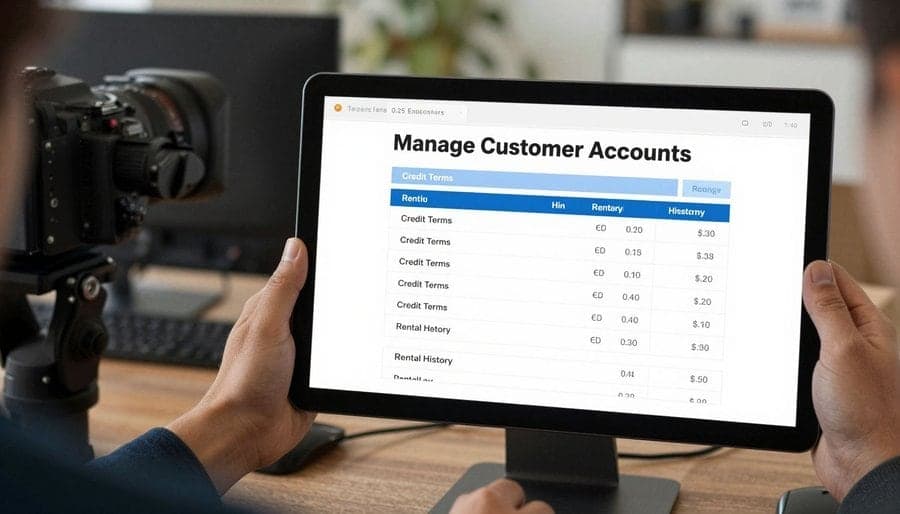
For a rental company, the useful version of customer relationship management is closer to a well-organized filing cabinet than a sales pipeline: one record per customer, holding their contacts, every order they've placed, the contracts and documents attached to those orders, and enough history that anyone answering the phone can see it at a glance.
This is the shape of the customer relationship tools built into Renttix: a customer account that carries its order history with it, rather than a separate database that someone has to keep in sync with the rental system by hand. When a customer calls to ask about extending a rental or querying an invoice, the person answering isn't running a discovery call to work out who they're talking to — the order history is already attached to the record in front of them.
That sounds like a small thing until you've worked the other way, with a standalone CRM that only gets updated when someone remembers to log a note, sitting next to a rental system that has no idea the CRM exists.

Repeat-order intelligence: rental is a repeat business by nature
Rental is one of the few sectors where repeat business isn't something you have to manufacture — it's built into how the work happens. A job finishes and another one starts. A tool wears out or a certification expires and needs replacing. A site clears out and a new one opens two miles away needing the same equipment. The demand for equipment recurs on its own; the question is whether anyone at the rental company notices when a customer is due to need it again.
That's a different problem from the one a sales pipeline solves. Nobody needs to be persuaded that they might want a breaker or a generator someday — they already know, because their work keeps needing one. What they need is a supplier who happens to be top of mind at the point the next job starts, and that's largely a function of who followed up last, not who ran the best marketing campaign.
As an illustrative example, picture a construction equipment rental company whose best customers are quietly the ones nobody ever follows up with. A general contractor rents a breaker and a mini excavator for every job they run, pays on time, and never complains — and because nothing about that relationship generates a support ticket or a complaint, nobody at the rental company proactively calls when the contractor's next job is due to start. The next rental goes to whichever supplier happens to call first, which isn't always the incumbent.
This is what repeat-order intelligence in Renttix is built to catch: it looks at a customer's ordering pattern and surfaces who's overdue for a repeat order or worth a proactive call, instead of leaving it to whoever happens to remember. It doesn't replace a salesperson's judgment, but it stops the quietly loyal customer being the one who gets forgotten simply because they never caused a problem.
Reminders, loyalty tiers and review requests: the lightweight version of 'nurture'
A dedicated CRM handles ongoing relationship-building with nurture sequences and marketing automation — scheduled emails, scored engagement, drip campaigns. Renttix's answer is smaller and more direct, built around the moments that actually happen in a rental business.
Automated reminders that chase without a person having to remember
Reminders can chase overdue invoices, flag agreements that need re-signing, or nudge a customer before equipment needs to go back off-hire — without someone on the office team keeping a running mental list of who to follow up with. Because these are automation rules, they can be tested with a dry run before they go live, and rolled back to a previous version if a change doesn't work the way it was meant to, rather than being edited live against real customers and hoped for the best.
Loyalty tiers and review requests
Loyalty tiers give repeat customers a reason to notice they're valued, and review requests ask for feedback at the point a job finishes — when the experience is fresh — rather than depending on someone remembering to ask weeks later. None of this replaces a relationship a good account manager builds in person, but it means the basic follow-through doesn't depend entirely on someone's memory on a busy day. Both sit inside Renttix's growth and automation tools, alongside the reminders and repeat-order intelligence.
Reducing the need to call the office at all
Some of the best relationship management is simply removing the reasons a customer needs to call in. Renttix's customer portal gives customers a place to check their live orders and what equipment is currently on site, pay an invoice, request an item go off-hire, sign an agreement, or manage a saved card — all without waiting for someone in the office to be free.
That matters for the same reason repeat-order intelligence matters: it's easy to assume relationship management means more contact, but for a lot of customers it means less friction. A contractor who can settle an invoice or request a pickup at 9pm without leaving a voicemail is having a better experience of the relationship than one who has to call during office hours and wait for a callback — even though nobody 'managed' anything in the traditional CRM sense.
When a dedicated CRM still earns its place
None of this means a rental business never needs a standalone CRM. If you're running a larger sales team chasing net-new accounts, managing a genuine multi-channel marketing operation across email, social and paid campaigns, or tracking a sales pipeline that goes well beyond 'quote to order', a dedicated CRM still does that job better than any rental system will, because that's what it's built for.
The practical answer for most rental businesses in that position isn't to choose one system and abandon the other. It's to keep the order and customer data live in the rental system, where it's created, and sync it into the CRM the sales and marketing team already uses. Renttix does this through HubSpot sync, so a sales team working in HubSpot isn't operating from a stale export while the rental system carries the real, current picture of every customer's orders.
If you're trying to work out how much of that you actually need — and how much is already covered by the customer and order data your rental system holds — it's worth talking it through. You can get in touch to walk through what that looks like for your business.
Frequently asked questions
Not for every business. Renttix keeps a customer record tied to order history, plus repeat-order intelligence, automated reminders, loyalty tiers and review requests, which covers what most rental businesses need day to day. If you run a larger sales team with a genuine multi-channel marketing operation, a dedicated CRM still has a role, and Renttix's HubSpot sync lets the two work from the same data rather than making you choose.
It's a feature inside Renttix's growth and automation tools that looks at a customer's past ordering pattern and flags when they're likely due for a repeat rental, or worth a proactive call, rather than relying on someone remembering to check. It's aimed at the naturally recurring demand of rental businesses — equipment needs that come around again once a job finishes — rather than a cold-outreach sales pipeline.
Yes. HubSpot sync is part of Renttix's growth and automation features, so customer and order data created in Renttix can flow into HubSpot for teams that run their sales and marketing activity there, instead of keeping two disconnected records of the same customer.
Explore Renttix
Ready to modernize your rental operations?
Payments + deposits enabled • Quick setup