Feature
Workshop Command Centre
A live board for every engineer, estimates customers approve online, and parts on the bench before the job stalls — the workshop run with the same discipline as the hire desk.
The whole workshop on one screen
Most rental businesses run the hire desk on software and the workshop on a whiteboard. Jobs live in someone's head, engineers find out what they are doing when they ask, and nobody can say what is blocked until it is late.
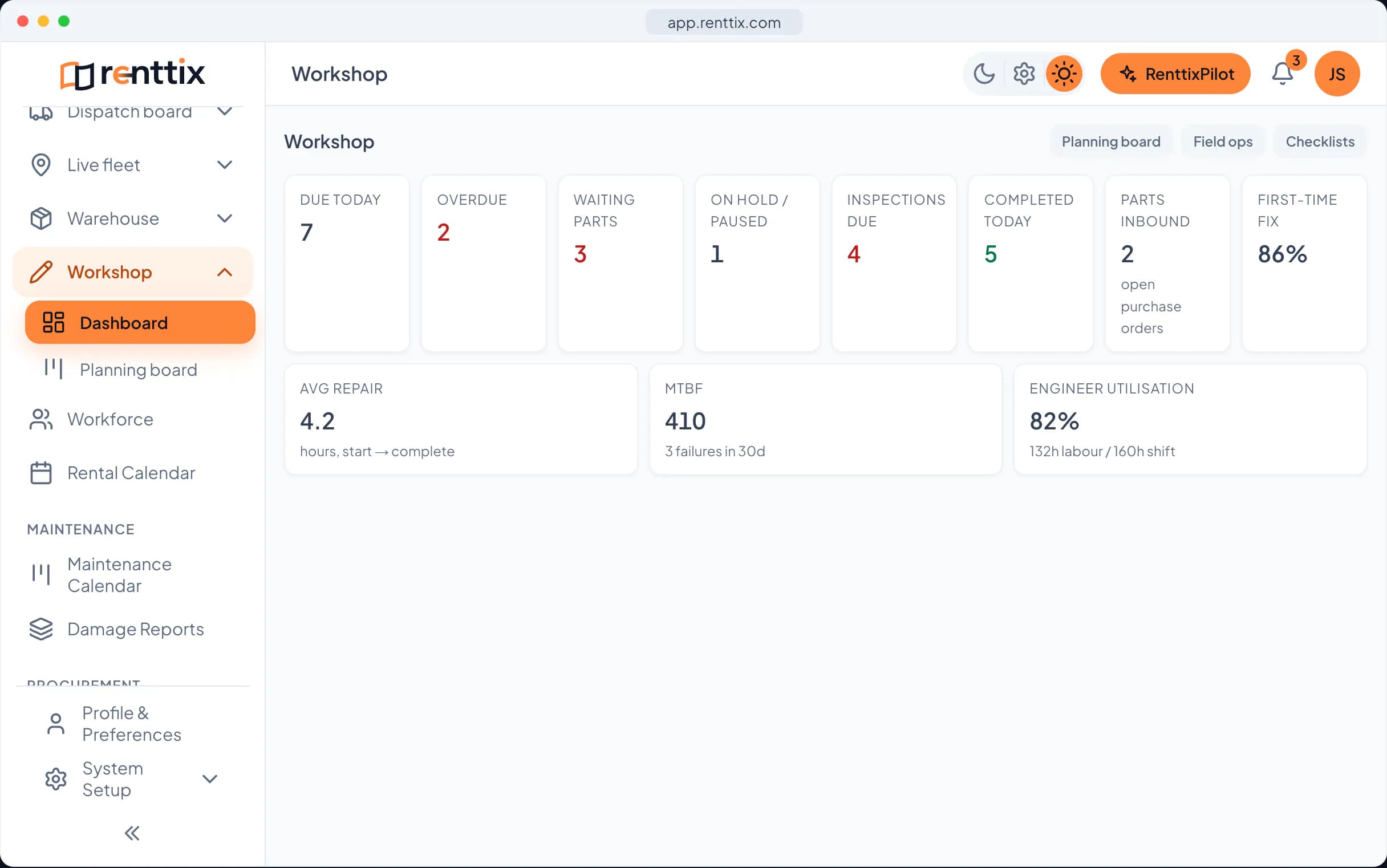
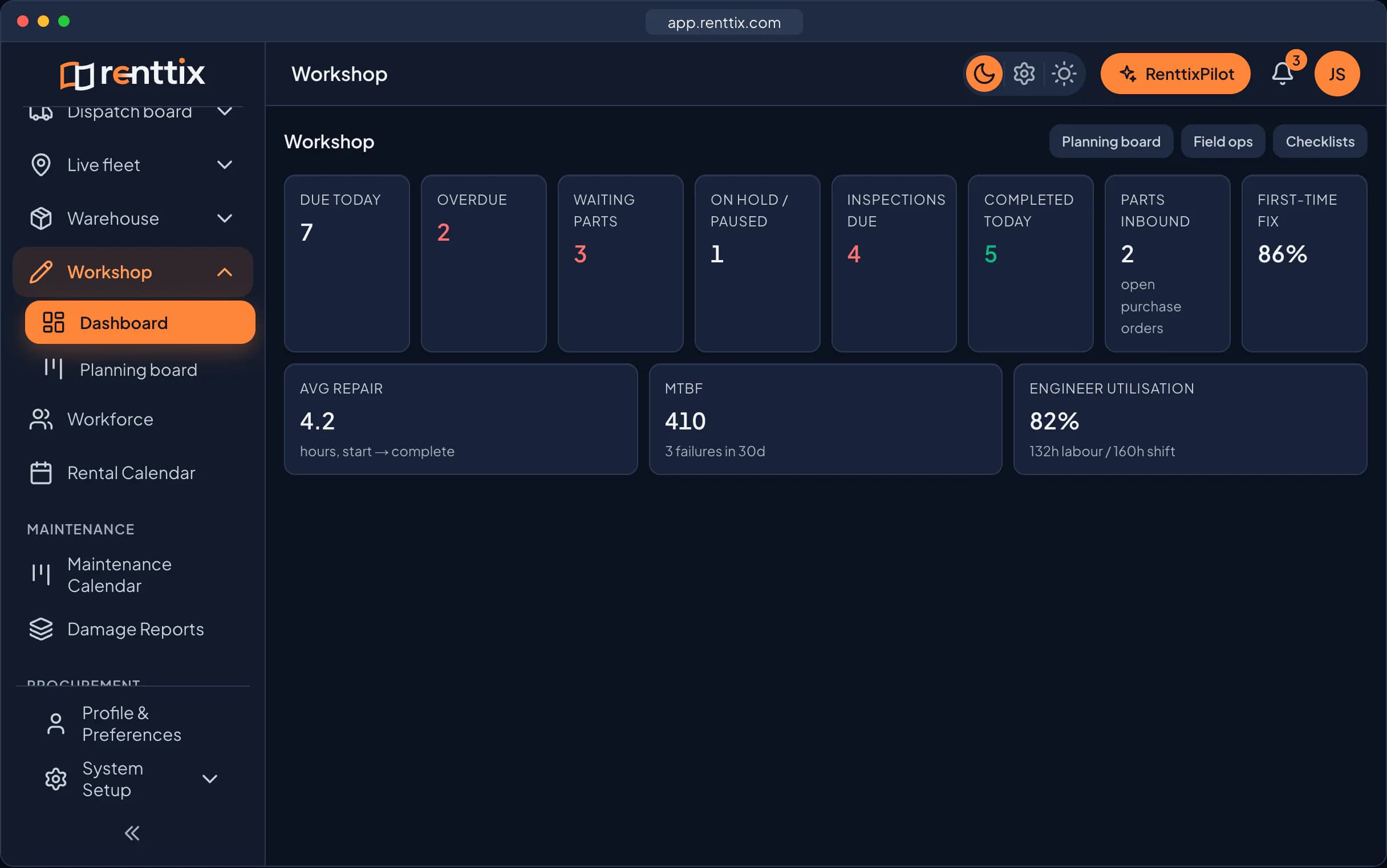
The Renttix workshop dashboard replaces the whiteboard with live tiles: what is due today, what is overdue, what is waiting for parts, what is on hold, which inspections are due, what was completed today, and which parts are inbound on open purchase orders. One glance answers the morning meeting.
The planning board turns assignment into a drag. One lane per engineer, plus a lane for unassigned work — drag a job card onto an engineer and it is theirs. Blocked jobs stay visible instead of buried, and jobs waiting for parts flag themselves so nobody starts work that cannot finish.
Underneath run the numbers workshop managers usually argue about from memory: first-time-fix rate, average repair hours from start to completion, mean time between failures, and engineer utilisation measured as labour hours against clocked hours. A repeat-failure table names the assets that keep coming back — the ones quietly eating your margin — so the fix-or-retire conversation happens with evidence.
Estimates customers approve — for your fleet and theirs
Chargeable repair work has an awkward moment: the point where you have priced the job but the customer has not agreed to pay. Handled by phone, it produces disputes. Handled by email, it produces delay.
Renttix prices the estimate — labour, parts, and carriage — through the same tax engine as your sales, honouring customer exemptions and the regional tax rules you have configured, then sends the customer a secure approve-or-decline link. No login, no account. They see the priced lines on any device, tap approve, and the estimate flips straight into a scheduled job. Declines are recorded with a reason, so 'I never agreed to that' has an answer either way.
This matters most for equipment your customers own. Renttix keeps a registry of customer machines — make, model, serial — separate from your rental fleet, and workshop jobs run against it just like your own kit. Servicing customer equipment stops being a favour tracked in a spreadsheet and becomes a revenue line with a process.
When a chargeable job completes, it bills as a sale — labour and parts at sell price, taxed line by line — feeding the same receipts, filing exports, and accounting integrations as everything else you sell.
Damage caught at the gate, parts ready on the bench
Two things decide whether a workshop keeps up: whether damage is caught when equipment comes back, and whether parts are there when the job starts.
The return inspection gate handles the first. When equipment comes off hire it passes through a checklist inspection: item-by-item results, a condition verdict from new down to condemned, photos, and a disposition — back to ready, off to cleaning, or into the repair queue. Failed items auto-raise a repair job linked to the inspection record, so damage becomes scheduled work the moment it is found rather than a surprise at the next hire. The record — checklist, verdict, photos — is also the evidence file when a damage charge or a deposit decision needs defending.
Parts management handles the second. Parts are allocated to jobs with cost and price snapshotted at the moment of allocation, so later price changes never rewrite what a job cost or charged. Stock is deducted once at completion, with an inventory log entry to show for it.
Behind the bench sit supplier catalogues — agreed prices, supplier part numbers, lead times — and an availability lookup that counts inbound purchase orders as well as shelf stock. When a part runs low, Renttix can draft the purchase order for you, ready for review rather than sent unseen. Engineers can request parts from the field — the job flips to waiting-for-parts, joins the dashboard's waiting-parts list, and stays flagged on the board until the parts arrive.
Follow one hire
Where this happens to R-2417
A sample hire: the customer and figures are made up. The statuses and screens are Renttix’s own.
Hire recordSample
R-2417
Step 8 of 9 · Inspect
- Condition
- 2 Ready · DM-1157 Quarantine
- WarehouseDM-1157: damage reported with photos
- Hire deskDamage report approved as chargeable
- WorkshopWorkshop job WJ-0519 opened; DM-1157 in quarantine
See this stage in the walkthroughSee this screen in the live demo
Workshop operations FAQ
What does the workshop dashboard show?
Live tiles for jobs due today, overdue, waiting for parts, on hold, inspections due, completed today, and parts inbound on open purchase orders — plus KPIs: first-time-fix rate, average repair hours, mean time between failures, engineer utilisation, and a repeat-failure table naming the assets that keep coming back.
How do customers approve repair estimates?
Each estimate generates a secure link — no login needed. The customer sees the priced lines, tax included, and approves or declines from any device. Approval flips the estimate into a scheduled job automatically; declines are recorded with a reason.
Can Renttix service equipment my customers own?
Yes. A customer equipment registry tracks machines by make, model, and serial, separate from your rental fleet. Chargeable jobs run against them with estimates, customer approval, and workshop scheduling, and completed work bills as a sale through your tax engine and accounting integrations.
What happens when equipment comes back damaged?
It passes a return inspection: a checklist with item-by-item results, a condition verdict, photos, and a disposition. Failures auto-raise a repair job linked to the inspection record, and the record itself gives you the evidence behind damage charges and deposit decisions.
Related features
Field Service Management
Give engineers everything they need to complete service jobs on site — checklists, parts, labour, and signed job sheets.
Testing, Inspections & Compliance
Statutory test regimes with regional presets, expiring certificates that chase themselves, and assets that cannot leave the yard non-compliant.
Asset Intelligence & Telematics
Know what every asset earns, costs, and is doing right now — lifecycle states, health scores, stock takes, and live telematics.
Billing & Revenue Automation
Bill open-ended hires, subscriptions and metered usage automatically — with late fees, refunds and depreciation handled by sweeps instead of spreadsheets.
AI Knowledge, Documents & Onboarding
An assistant that has read your documents, searches your records by meaning, remembers how you work — and sets new businesses up in a free guided conversation.
Online Store & Booking Widgets
Take bookings from your website, your webshop, or a store we host — with availability and deposits handled by the platform.
Growth & Automation
Automation rules with dry-run and rollback, reminders that chase for you, loyalty and reviews that bring customers back.
Open your first hire record today
14-day free trial · Payments and deposits ready · Quick setup