

Published September 22, 2026
When the Season Is the Business
Most rental categories spread demand across the year. Sports and outdoor rental rarely does. A ski shop's entire winter might come down to eight or nine weeks around the holiday season and school breaks. A wetsuit and paddleboard rental counter on the coast might do more business in six sunny summer weekends than in the other forty-six weeks combined. A campground's tent and camping gear desk lives and dies by a run of dry Saturdays between May and September. Whatever the sport, the pattern is the same: a short, weather- and calendar-driven peak window in which almost everything has to go right, surrounded by long stretches of quieter trade.
That alone would make sports and outdoor rental a demanding category to run. What makes it distinctive is a second pressure layered on top of the first: getting the right item to the right person matters just as much as simply having enough stock on the shelf. A furniture rental business that has a sofa in stock has, in a meaningful sense, solved the problem. A ski rental shop that has skis in stock has not — not until those skis are matched to the right length, the boots to the right size, and the bindings set for the right weight and ability. Get it wrong and the result isn't a minor inconvenience the way a slightly-wrong-color chair might be; it's a customer who can't control their skis, a wetsuit that lets in cold water at the seams, or a bike that's the wrong frame size for a day on unfamiliar trails. In this category, fit is a safety question as much as a service one.
Running a sports and outdoor rental operation well means solving both problems in the same short window: filling the peak days efficiently, and making sure every item that goes out the door fits the person taking it. Renttix has a dedicated Renttix for sports equipment rental businesses offering built around exactly that combination — booking and payment handled ahead of time, sizing captured against the booking rather than guessed at the counter, and maintenance tracked so equipment that's been out in the wind, salt water and mud all season stays safe to rent out again.
Why Pre-Booking and Pre-Payment Matter More in a Peak-Driven Business
In a business with steady, year-round demand, the odd walk-in booking or last-minute cancellation barely registers. In a business where most of the year's revenue is squeezed into a handful of peak weekends, both matter enormously. A no-show on the first Saturday of spring break isn't a gap that fills itself later; that slot, and the equipment tied up for it, is gone for the day.
This is where online booking and pre-payment carry more weight in sports and outdoor rental than in almost any other rental category. When customers can reserve and pay for their equipment online ahead of a peak day, that day starts filling in advance rather than being left to chance on the morning. A family booking ski rentals for the first Saturday of the holidays, or a group booking paddleboards for a sunny long weekend, commits to the slot and the payment before they arrive — which means fewer no-shows eating into a window that's already short, and a much clearer picture, days or weeks out, of how busy any given peak day is actually going to be. Renttix's online rental booking workflow is built for exactly this: reservation and payment happen together, online, ahead of the visit.
The knock-on effect at the counter is just as important as the effect on the calendar. When a booking has already been made and paid for, the person behind the counter on a busy Saturday isn't spending their limited time per customer taking a booking, working out availability, or processing payment — they're handing over the right gear and getting the customer out the door. On a day when a ski rental shop might be serving its busiest few hours of the entire season, that shift — from taking a booking to handing over gear — is often what determines whether the line moves or backs up out the door. It's a small change in where the counter's time goes, but in a business where nearly all the trade happens in a handful of short windows, it's one of the differences between a peak day that runs smoothly and one that doesn't.
Getting the Right Size to the Right Person
Availability solves half the problem in sports and outdoor rental; fit solves the other half, and it can't be solved in the thirty seconds a busy counter has for each customer. Sizing someone for skis, boots, a wetsuit or a bike properly takes into account their height, weight, ability, and sometimes their previous experience with that exact kind of equipment — information that's awkward to gather accurately when there's a line building behind them.
This is why capturing sizing and fit details against the booking, rather than relying on a rushed conversation at the counter, changes how a peak day runs. With Renttix's customer sizing profiles, a customer's size, weight and ability are recorded against their booking, so staff already know what they're looking for before the customer reaches the front of the line — rather than working it out from scratch, under time pressure, while other customers wait. That matters for first-time renters, who need the most guidance and the most accurate fitting, and it matters just as much for returning customers: someone who rented the same size skis or the same wetsuit last season doesn't need to be re-measured every visit, so staff can move them through faster while still handing over gear that actually fits.
The effect compounds across a peak day. Multiply a few minutes saved per customer by the volume that moves through a rental counter on the busiest Saturday of the season, and the sizing step is no longer a small convenience — it's a meaningful part of how many customers can be served properly before the day is done. It also reduces the number of mid-rental returns and exchanges, where a customer comes back an hour in because the boots are rubbing or the wetsuit is too tight through the shoulders, which cost far more staff time to resolve than getting the size right the first time would have.
Keeping Outdoor Equipment Serviceable Between Rentals
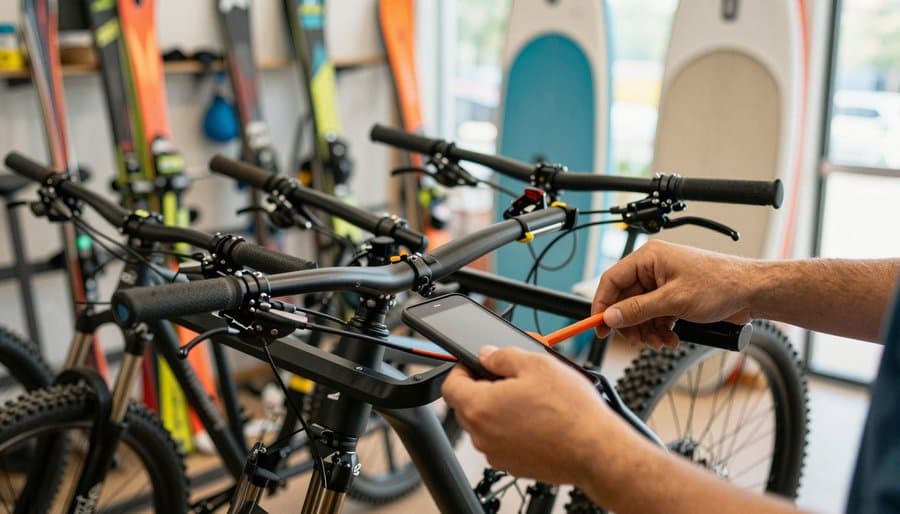
Sports and outdoor equipment doesn't sit quietly in a store between rentals the way a lot of other rental stock does. It goes into the ocean, down a mountain, across muddy trails and into the hands of people ranging from complete beginners to confident regulars — and it comes back scuffed, salted, stressed, or simply worn down a little more than it was the week before. Bindings loosen, wetsuit seams weaken, bike brakes wear, edges dull. None of that shows up reliably just by looking at a rack of gear between customers, especially not in the middle of a busy day when the priority is turning the next rental around quickly.
Left unmanaged, that's exactly the kind of thing that gets missed under peak-season pressure — not through carelessness, but because remembering which of dozens of similar-looking units is due a check, in the middle of a rush, is not a realistic ask of anyone. Renttix's scheduled maintenance and servicing addresses this by flagging equipment for servicing based on a set number of rentals or a fixed period of time, rather than leaving it to memory. Once a unit hits its threshold, it can be held off-rental until the check is actually logged as complete — so equipment that's due attention can't accidentally go back out to the next customer because the shop was busy and nobody had a moment to think about it.
That combination — a trigger that doesn't rely on anyone remembering, and a hold that doesn't let equipment slip back into circulation unchecked — is particularly suited to a category where the equipment is used outdoors, rented out repeatedly in short succession, and where a fault that would just be an inconvenience in some other rental category can be a safety issue here. It's covered as part of the same Renttix for sports equipment rental businesses approach that handles booking and sizing, so maintenance status sits alongside the rest of the rental record rather than being tracked separately. Renttix's workshop operations tools support the servicing and check-off work itself once a unit is flagged.
A Saturday Morning at a Ski Rental Shop
The following is illustrative rather than an account of a specific business, but it's a fair sketch of how the pieces fit together on a peak day.
It's the first Saturday of spring break, and a ski rental shop at the base of a resort is about to have one of its busiest mornings of the season. Over the previous two weeks, most of that morning's customers booked and paid for their skis, boots and poles online, entering their height, weight and ability as part of the booking. By the time the doors open, the shop already knows roughly how many sets of gear it needs pulled and in what sizes — no guessing, no scramble to check availability against a paper log.
As families arrive, the counter staff aren't starting from zero with each one. A returning family who rented the same sizes the previous season are matched to their usual gear and out the door in a few minutes. A first-time family has their recorded height, weight and ability waiting for them, so staff can go straight to fitting rather than starting the conversation with a string of questions while a line forms behind them. Through the busiest hour of the morning, the counter's job is almost entirely about handing over the right gear quickly — not taking bookings or working out who needs what.
In the workshop behind the counter, a handful of ski sets have hit their scheduled-service threshold after a run of rentals earlier in the week. They're held off-rental until a technician has checked and logged them, so they're simply not part of what's available to hand out that morning — which means nobody at the counter has to make a judgment call, mid-rush, about whether a particular pair looks fine to send out again.
None of this removes the pressure of a short, intense peak window. What it changes is where that pressure lands: on getting gear fitted and handed over quickly, rather than on taking bookings, chasing sizing information, or deciding on the spot whether a piece of equipment is safe to rent out.
Booking, Fit and Maintenance Are One Problem, Not Three
It's tempting to treat booking, sizing and maintenance as three separate operational concerns in a sports and outdoor rental business, each solved with its own fix. In practice, they're facets of the same underlying problem: a short, high-pressure peak window in which the business needs to serve as many customers as possible, correctly, without anyone getting hurt by ill-fitting or unsafe gear.
Pre-booking and pre-payment fill the peak days in advance and free up counter time. Sizing profiles get that time spent fitting gear rather than gathering information that could have been captured earlier. Scheduled maintenance with a hold-until-checked gate keeps equipment that's been out in the elements safe to hand over again, without relying on anyone remembering which unit needs attention. None of the three works as well in isolation as it does alongside the other two — which is the reasoning behind building them into a single Renttix for sports equipment rental businesses offering rather than as separate add-ons.
For a business where the season, the weather and the size of the next customer through the door all set the terms, that combination is less about adding features and more about matching the software to how sports and outdoor rental actually works. Get in touch to see how it fits a particular sports or outdoor rental operation.
Frequently asked questions
Yes. Renttix's online booking and pre-payment lets customers reserve sports equipment — skis, wetsuits, bikes, camping gear and similar equipment — and pay ahead of their visit. That fills peak days in advance, reduces no-shows, and means the counter is handing over gear rather than taking bookings and payments on the day itself. See [Renttix's online rental booking](/en-us/workflow/online-rental-booking) workflow for how the reservation and payment step works.
Renttix's customer sizing profiles capture a customer's size, weight and ability against their booking, so staff know what to pull before the customer reaches the counter. First-time renters get fitted from recorded information rather than a rushed conversation, and returning customers who rented the same gear before can be matched to it quickly rather than being measured again from scratch. This is part of [Renttix's sports equipment rental](/en-us/industries/sports-equipment-rental-software) offering.
Renttix's scheduled maintenance and servicing flags equipment for a check after a set number of rentals or a fixed period of time, rather than relying on staff remembering. Once flagged, the unit is held off-rental until the check has actually been completed and logged, so it can't accidentally go back out to the next customer before it's been looked at. The servicing and check-off work itself is handled through Renttix's [workshop operations](/en-us/features/workshop-operations) tools.
Explore Renttix
Ready to modernize your rental operations?
Payments + deposits enabled • Quick setup