

Published September 22, 2026
A Site Cabin Doesn't Behave Like a Short Rental
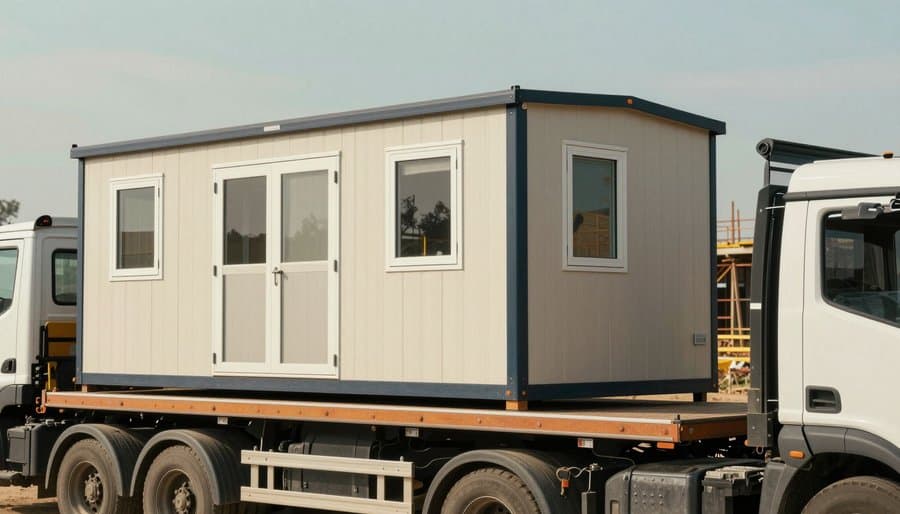
A site cabin or welfare unit doesn't behave like most things going out on rent. It doesn't leave the yard on a Monday and come back on a Friday. It goes out once — craned onto a construction site or positioned on an event ground, connected to power and water — and then it stays there. Weeks turn into months. The site manager who ordered it barely thinks about it again, except to expect that it's clean, working, and billed correctly for every single period it stays on rent.
That's the operational reality behind portable accommodation and welfare rental: long rental periods, site logistics, and units that need servicing while they're still out on rent rather than back at the depot. Renttix's portable accommodation rental industry page describes exactly this pattern — cabins and welfare units delivered to construction and event sites, connected up, and often staying on rent for months with regular cleaning and servicing scheduled throughout that time.
Three things fall out of that pattern, and they're the three that decide whether an operation runs cleanly or turns into a monthly scramble: how the rental gets billed correctly for months on end without anyone re-keying a charge, how servicing gets planned and actually completed against a unit sitting on someone else's site rather than the depot, and how the business keeps track of exactly where every unit in a scattered fleet currently is, right now, not from the last time someone checked.
Recurring Billing Is the Right Model for a Rental That Runs for Months
A short-term rental is simple to bill: the unit goes out, it comes back, one invoice covers the period. A welfare unit on a six-month sitework contract doesn't fit that pattern at all. It has to be billed every period it's out — typically monthly — for as long as the contract runs, and each charge has to reflect exactly how long the unit was actually on rent, including the periods where the rental starts or ends partway through rather than on a neat billing-cycle boundary.
This is why recurring billing, rather than a queue of manually raised invoices, is the right model for this kind of rental. Renttix bills ongoing rentals on automatic recurring cycles, calculating part-period and off-rent charges precisely, so a long-running contract stays invoiced correctly without anyone having to recalculate the charge by hand every time a billing period comes round.
Part-period charges
Recurring billing runs against the rental itself, so the system already knows when the unit went out and can work out what a partial first period should actually cost — rather than defaulting to a full period charge that overstates what the customer owes, or a rounded-down charge that quietly undercharges the business.
Off-rent charges
The same logic applies at the other end of the rental. When a unit comes off rent partway through a billing period, the final charge needs to reflect exactly how many days it was actually out, not the full period and not a guess. Getting this right on every unit, every period, for a fleet that's constantly starting new rentals and ending others, is what automatic recurring billing is built to do — and what makes a six-month or twelve-month cabin rental something that stays correctly invoiced without turning into a standing task on someone's desk every month.
What Manual Re-Invoicing Gets Wrong
The alternative — someone manually raising or checking an invoice for every unit, every period — sounds manageable when a business has five cabins out. It stops being manageable at forty, spread across a dozen sites with different start dates, different contract lengths, and different off-rent dates landing in different weeks. Two failure patterns show up reliably once billing is done by hand at that scale.
The first is the missed period. A unit that went out in March gets invoiced correctly for March and April, and then the person doing the invoicing runs out of time, or simply loses track of which units are still live, and May slips through. Nobody notices until the customer's finance team queries a gap in the paperwork, or until someone reconciles rental income against the fleet and finds a unit that's been sitting on a site for two months generating no revenue at all.
The second is the wrong part-period charge. A site job that was meant to run to the end of the month finishes three weeks early, or overruns by two weeks into the next period, and whoever is raising the invoice either charges a full period regardless — which the customer is likely to query, and which does the relationship no favours — or has to manually work out the correct pro-rata figure. That's exactly the kind of calculation that's easy to get wrong under time pressure, with forty other units also needing invoices raised that same week.
Neither failure is really a one-off mistake. They're the predictable result of trying to do period-by-period, part-period-aware billing by hand across a fleet where units are constantly starting, ending, and running mid-contract at the same time.

Scheduling and Tracking Servicing on a Unit That's Sitting on Someone Else's Site
A welfare unit doesn't stop needing attention once it's delivered. Cabins on long-term rental need regular cleaning and servicing throughout the period they're on site — and because the unit isn't coming back to the depot for that to happen, the servicing has to be planned, scheduled, and carried out on-site, on a recurring basis, for as long as the rental runs.
Renttix supports this directly: a business can schedule recurring cleaning and servicing visits against each unit on rent, assign those visits to routes and drivers, and record when each one is actually completed. That turns servicing from something that has to be remembered into something that's planned against the unit for the life of the contract and tracked through to completion — the same visits assigned to routes and drivers alongside deliveries and collections, rather than run as a separate, informally tracked process on the side.
The reason this matters more here than it would for, say, a tool sitting unused in a yard is that a missed servicing visit on a welfare unit isn't just an internal admin slip — it's a problem the site client experiences directly. A welfare cabin that hasn't been cleaned on schedule is a facility that workers on-site are actually using, on a job the client is paying for, and it reflects on the rental company whether or not anyone in the office notices the gap.
For a business running dozens of units across multiple sites, the only way to be confident that every scheduled visit has actually happened — not just that it was planned — is to have those visits recorded against the unit and checked off as complete, rather than relying on a driver's memory or a paper sheet that never quite makes it back to the office.
Knowing Which Site Every Unit Is On — and When It's Due Off Rent
Knowing which site every unit is currently on, when it was delivered, and when it's due off rent matters in a way it simply doesn't for a fleet that lives in one yard. A rental business running dozens of cabins across a scattered set of live sites is managing a fleet that's mostly out of sight, for months at a time, on other people's property.
Renttix gives a business site-level asset location tracking for exactly this reason: it shows which site every unit is on, when it was delivered, and when it is due off rent, so the fleet's deployment is always visible rather than reconstructed from memory, spreadsheets, or a phone call to whichever driver last visited that site.
That visibility does two jobs at once. Operationally, it's what lets someone plan a collection run, schedule the next servicing visit, or answer a customer's question about a specific unit without first having to work out where the unit even is. Commercially, it's what keeps the portable accommodation side of the business connected to the billing side of it — a unit that's still showing as on-site is a unit that should still be generating a recurring charge, and a unit that's overdue to come off rent is one the business needs to be actively following up on, rather than one that's quietly fallen off both the invoicing and the tracking at the same time.
A Fleet Spread Across a Dozen Sites: An Illustrative Example
Illustrative example: picture a welfare unit rental company running forty cabins across a dozen active construction sites. Some units are barely a month into a long contract; a few are due to come off rent this month; a handful are sitting on sites where the sitework job has quietly overrun and nobody in the office has been told yet. None of that is unusual for a fleet this size — it's the normal, constantly shifting state of a portable accommodation business at any given point in time.
Without a single, reliable view of that fleet, the office is working from whatever it can piece together: a spreadsheet that's a week out of date, a driver's memory of which sites they visited last, a folder of delivery notes. Billing runs off that same patchy picture, which is exactly how a unit ends up sitting on a site for two months generating no invoices, or how a servicing visit gets missed because nobody flagged that the unit was still out there.
With site-level tracking, recurring billing, and scheduled servicing all running against the same forty units, the picture changes. The office can see at a glance which sites are due a collection this month, which units are mid-contract and should be generating their next recurring charge, and which are due a cleaning visit this week — without phoning around or waiting for a driver to remember. That's the practical difference between managing a scattered fleet by memory and managing it with visibility built in.
Bringing Billing, Servicing, and Location Together
None of these three things — recurring billing, planned servicing, and site-level location tracking — solves the whole problem on its own. A business that bills correctly but has no visibility of where its units are will still miss off-rent dates. A business that tracks location well but still bills manually will still lose revenue to missed periods and miscalculated part-charges. A business that does both but has no record of whether a servicing visit actually happened will still end up with a complaint from a site client whose cabin hasn't been cleaned.
What makes portable accommodation and welfare rental manageable at scale is having all three run against the same record for each unit — the rental that's generating a recurring charge, the servicing visits scheduled and completed against it, and the site it's currently sitting on — rather than three separate systems, or three separate habits, that someone has to keep in sync by hand. That's the case for treating recurring billing, on-site servicing, and fleet-wide location visibility as one connected part of running a portable accommodation and welfare rental business, rather than three separate problems solved with three separate workarounds.
For a business weighing up whether its current approach to billing, servicing, and tracking a long-term rental fleet is holding up as it grows, it's worth seeing how this works in practice — book a demo to see recurring billing, planned servicing, and site-level tracking running against a live portable accommodation fleet.
Frequently Asked Questions About Portable Accommodation Rental Software
Renttix bills these rentals on automatic recurring cycles rather than one invoice per rental. Each cycle calculates the correct charge for that period, including precise part-period charges when a rental starts partway through a billing cycle and precise off-rent charges when it ends partway through one — so a cabin that's out for six or twelve months stays correctly invoiced throughout, without anyone needing to recalculate the charge by hand each period.
Renttix lets a business schedule recurring cleaning and servicing visits against each unit while it's on rent, assign those visits to routes and drivers alongside deliveries and collections, and record when each visit is actually completed. That keeps servicing planned and tracked for the life of the contract, even though the unit itself never comes back to the depot.
Renttix provides site-level asset location tracking that shows which site every unit is currently on, when it was delivered there, and when it's due off rent. That gives the office a live view of where the whole fleet is deployed, rather than having to reconstruct it from spreadsheets, delivery notes, or a phone call to a driver.
Explore Renttix
Ready to modernize your rental operations?
Payments + deposits enabled • Quick setup